


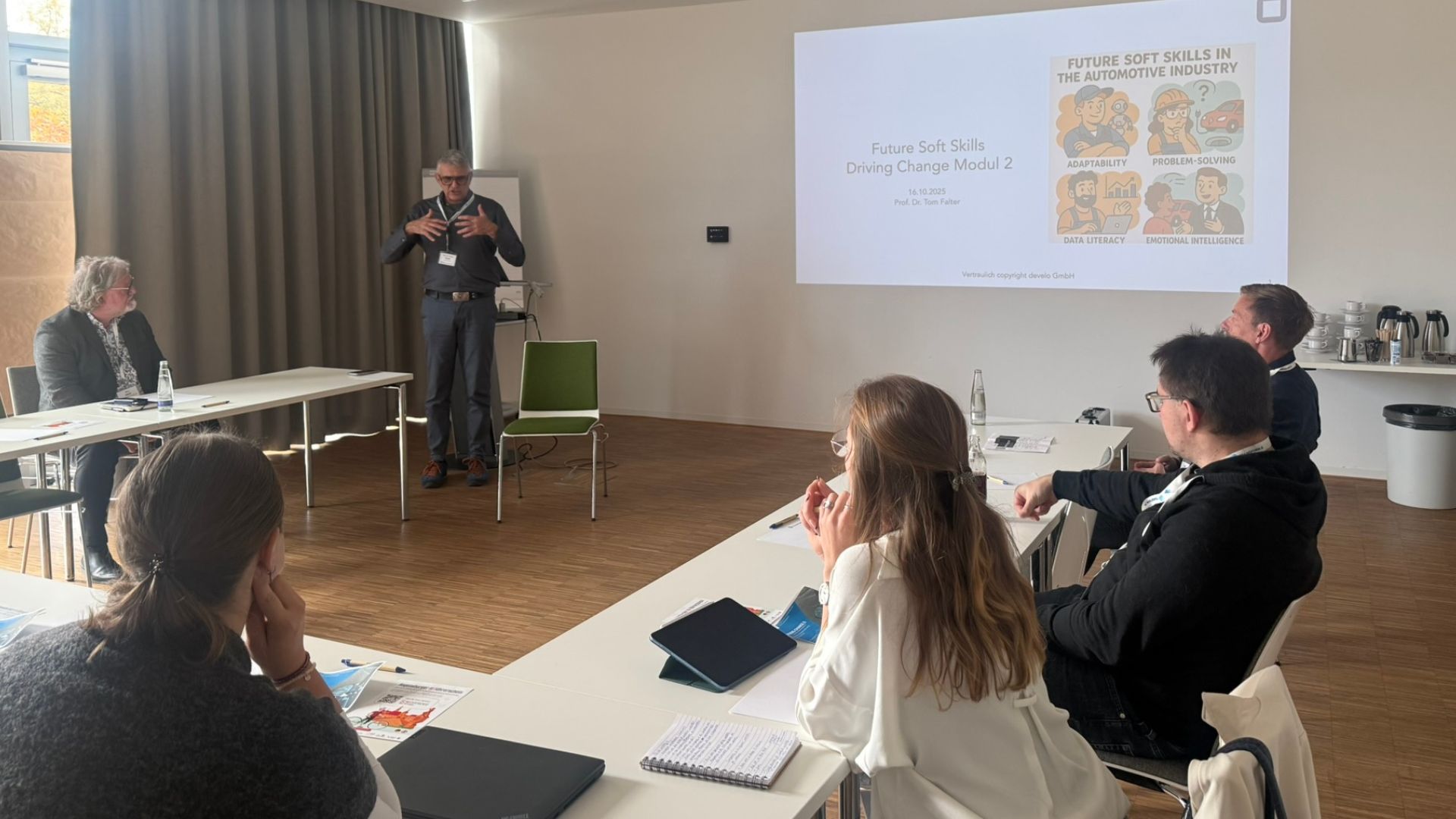
On October 16, 2025, the module “Driving Change II: Future Soft Skills” took place at TechBase Regensburg. The event focused on developing essential social and general competencies for change in the automotive industry.
The central question of the workshop: Which skills ensure success during change?
The workshop emphasized that successful change depends heavily on a willingness to change and interdisciplinary collaboration.
Future soft skills, particularly analytical thinking and resilience, flexibility, and agility, have also been identified by the WEF as top core skills.
The foundation for developing these skills lies in distinguishing between ability (skills) and willingness (values). The Job-Fit Model shows that only the alignment of skills (Skill-Fit) and motivation/values (Energy-Fit) leads to performance and flow.
The workshop’s conclusion: Personalized learning concepts as the key
The decisive key to closing competency gaps lies in the use of personalized training concepts. These must be tailored to employees’ individual knowledge levels, values, and mindset.
To achieve this, learning must transition from conventional knowledge transfer to regenerative learning. Regenerative learning is an energy booster and is characterized by immediate benefits, job fit, and meaning. AI-supported, action- and results-focused micro-learning is essential for this, as it enables a high degree of personalization.
In conclusion, we would like to thank the module’s speaker, Prof. Dr. Thomas Falter, for his expert input and practical insights into the necessary soft skills.
Note
The event was part of the German Federal Government’s (BMWE) Transformation Networks. The Regensburg-based project transform.r supports companies in navigating structural change in the automotive industry.