


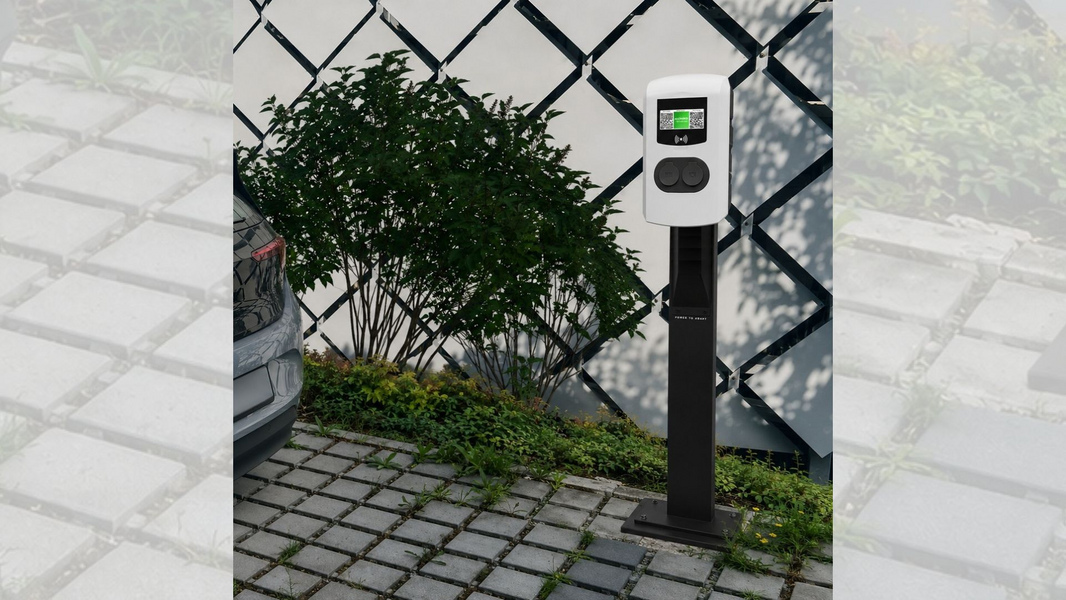
BiDi Digital EV Charging Hub at TechBase (BIDEV)
At the R_Lab Mobility, a practical demonstrator for bidirectional public charging infrastructure and smart car park monitoring is being developed in collaboration with AI-Charge Technologies GmbH. At the TechBase East site, a bidirectional charging point with two charging ports is being installed and fitted with a sensor unit to detect car park occupancy and monitor operations.
Among other things, the project will test vehicle-to-grid applications, Plug & Charge, AI-supported load management and the reliable collection of charging, occupancy and environmental data. The resulting data will be transmitted via standardised interfaces to the R_Lab Mobility Mobility Data Hub.
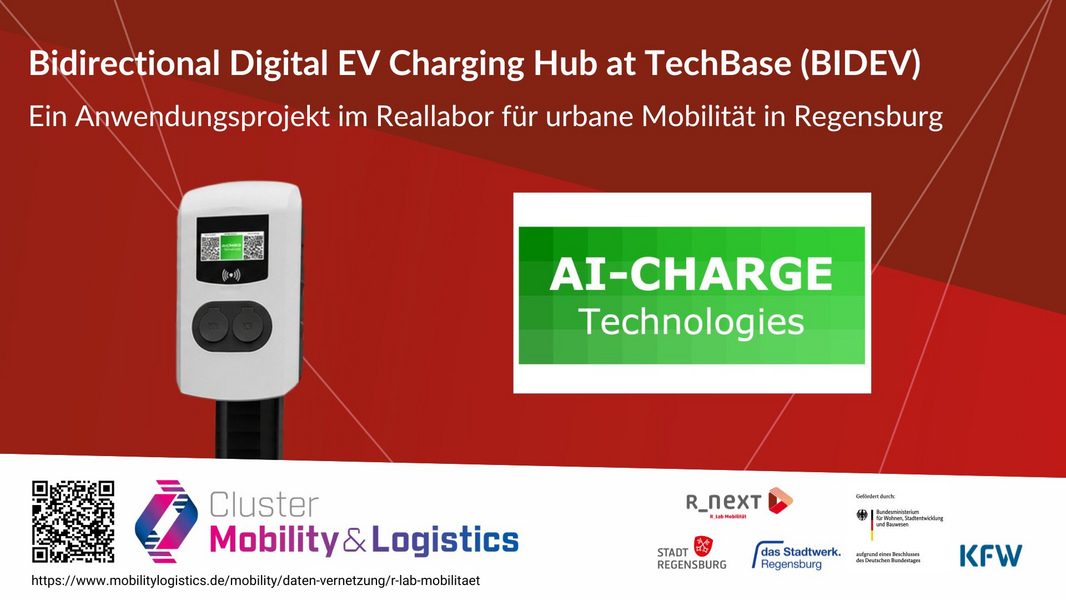
>>> To the image film (coming soon) about the project BiDi Digital EV Charging Hub at TechBase (BIDEV). <<<
Goals
The aim of the project is to trial bidirectional charging in public spaces. The test will examine how electric vehicles can not only draw electricity but also make their battery capacity available for local energy optimisation and, in the long term, for stabilising the electricity grid.
At the same time, the sensor technology is intended to provide insights into the actual use of the charging points: How often are they blocked by vehicles without any charging taking place? How reliably do the various access and charging procedures work? And what technical or user-related problems arise during operation?
Benefits
Funded project period: July 2026 – December 2026
Pilot operation and evaluation: until Q3 2027
The BIDEV project is an application project within R_Lab Mobility, real-world laboratory for urban mobility of the R_NEXT smart city project.
Relevance for Urban Development & Smart Cities
The pilot project contributes to strategic urban development policy elements of the Regensburg Plan 2040 in the areas of mobility and the digital and smart city. The integration of charging infrastructure, the energy grid, sensor technology and mobility data makes it possible to test new approaches to low-emission, connected and data-driven urban development in practice.
The pilot project is intended to help
The use of open standards and documented interfaces is intended to enable the scheme to be rolled out to other locations. The data collected also provides a basis for research, urban planning and future smart city applications.
Uwe Pfeil
Clustermanager
Tel. +49 941 604889 55
uwe.pfeiltechbase.de