


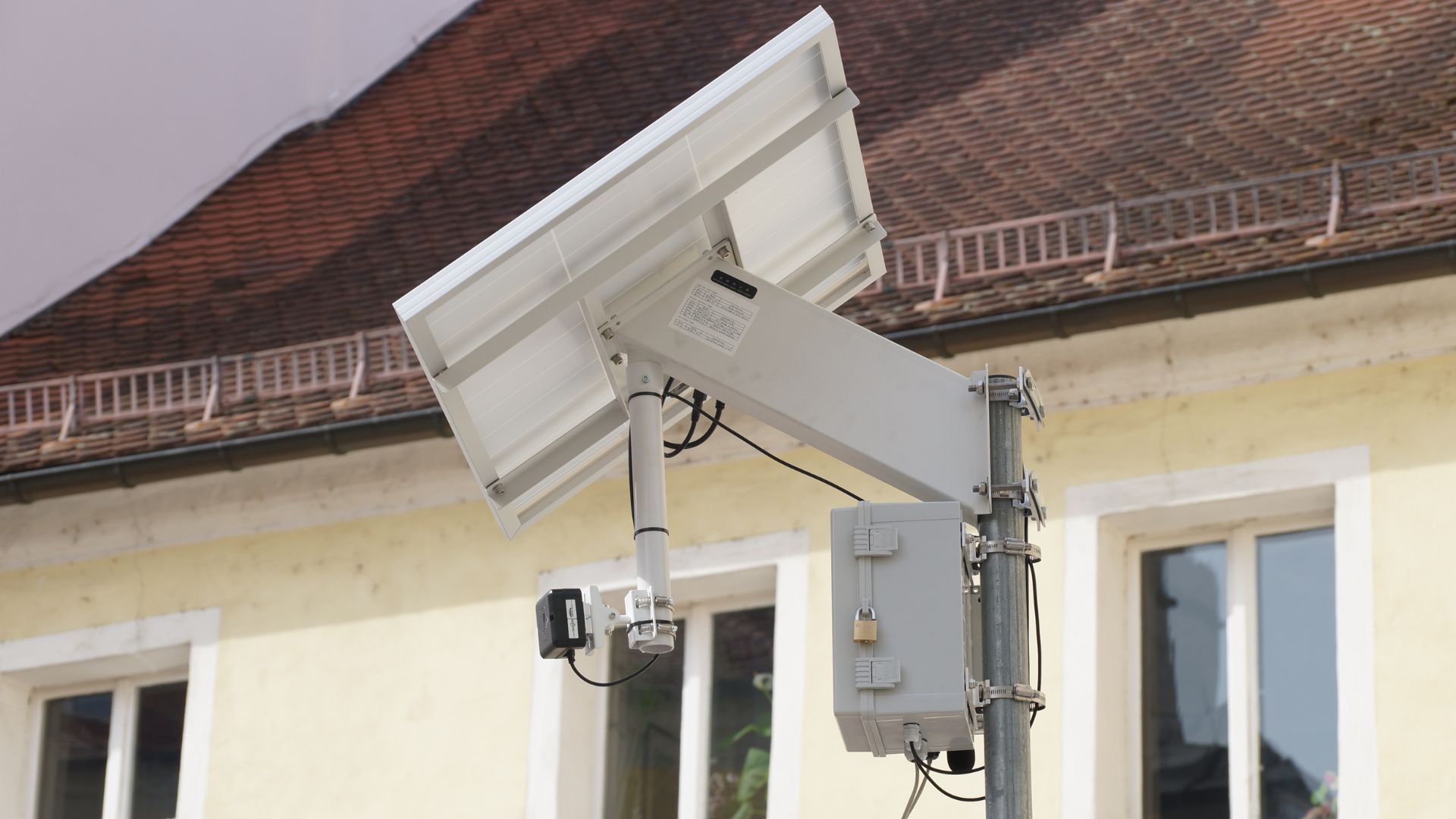
Photo: Kreativbehörde Regensburg
The Context: Regensburg as a Smart City Testing Ground
Since 2022, Regensburg has been one of the federally funded “Smart Cities” pilot projects (REGENSBURG_NEXT). At the heart of the initiative is the R_Lab Mobility—a real-world laboratory where companies, universities, and city officials test smart applications under real-world conditions. Stadtwerk.Regensburg operates the central data infrastructure, the Mobility Data Hub; the Mobility & Logistics Cluster coordinates the real-world lab. One of the application projects is WiSe OMV—Impact Measurement & Sensor Technology in the Obermünsterviertel. The project has been running since March 2026 on behalf of the City of Regensburg.
The project: From motion and frequency analysis, microclimate, air quality and noise level trend analyses, right through to testing data transmission technology in the historic old town
Ahead of the comprehensive redesign of the Obermünsterviertel starting in 2028, the real-world lab has been evaluating the impact of temporary emergency measures (traffic calming, greening, public gathering spaces) since 2026. A modern sensor network at five fixed points, along with a mobile measurement box (box in use from November 2026), provides real-time data anonymously and without cameras (Privacy by Design) to the Mobility Data Hub. While the Strategic Partnership for Sensor Technology (Strategische Partnerschaft Sensorik e.V.) is responsible for technical implementation, the Mobility & Logistics Cluster manages project coordination.
An Overview of the Sensor Setup:
Which sensors are used—and what do they do?
- Motion & Frequency: Optical-free radar systems detect pedestrians, cyclists, and vehicles.
- Environment & Microclimate: IoT sensors for air quality, temperature, CO₂, and humidity measure heat island effects and the impact of green spaces.
- Acoustics: Sound level measurements analyze sound emissions and nighttime noise peaks.
- Data Fusion & Visualization: Data aggregated on-site is transmitted to the data hub via cellular networks and processed for specialized agencies using customized web dashboards (e.g., 2D noise hotspots). CIVITAS/CORE is the open-source foundation of the Mobility Data Hub. The optional Apache Superset add-on is used for visual data analysis and dashboards.
Challenges in Urban Environments: What the Real-World Lab Solves
The use of modern IoT technology in public spaces differs fundamentally from that in restricted automotive test sites or industrial areas. From a technical standpoint, historic preservation requires unobtrusive, often energy-self-sufficient solutions: Many sites lack a standard power connection. The project team therefore designed the sensors to be solar-powered and wireless—including data transmission through historic masonry.
“When tackling new areas of focus, there’s a lot that’s unknown at first—from the stakeholders and their responsibilities to the requirements under historic preservation regulations,” emphasizes Matthias Streller, Managing Director of the Strategic Partnership Sensorik (SPS). “A real-world lab is the ideal framework for overcoming these hurdles collaboratively and pragmatically.”
To this end, WiSe OMV brings together the historic preservation authority, city administration, municipal utilities, and the network to define common standards for installation, data flow, and operation even before installation begins. Clarifying all responsibilities at an early stage proved to be a key success factor and the most important lesson learned for comparable projects in other municipalities.
The Network Effect: Technology Transfer & A Bridge to the Automotive Industry
So what does this have to do with the automotive sector and transformation? For medium-sized technology providers and companies in the automotive supply industry, the real-world lab opens up new perspectives as they seek new fields of application beyond the traditional vehicle in the wake of structural change. While networks such as the Strategic Partnership Sensorik or transform.r do not operate their own test sites, they act as an interface and technology facilitator in this context. “Radar, perception, and environmental sensor technology developed in the automotive sector is also technologically relevant for the smart city sector,” says Streller. There are also lessons to be learned for automotive applications—for example, regarding the installation of infrastructure sensors for Vehicle2X or where potential exists for shared datasets.
Network partners such as Sensorik-Bayern GmbH and Senseca demonstrate how this transfer works in practice with their systems already integrated into ongoing operations—a potential that is also reflected in the interest shown by renowned Tier 1 suppliers during initial exploratory talks.
The Outlook: From Pilot Project to Citywide Infrastructure
With the start of the second project phase, the team has expanded its measurements to include mioty wireless technology and is extending the impact assessment to Neupfarrplatz, where shading elements and misting systems are being installed as part of the Climate Lab. All data is consolidated in the Mobility Data Hub and integrated into Regensburg’s citywide IoT concept—the foundation for future sensor-based applications extending far beyond the Obermünster district.
Why the Network Is the Decisive Factor Here
Individual companies would have had little chance of gaining this access to the urban test bed—coordination with historic preservation authorities, city administration, and data protection requirements in the World Heritage district is simply too complex. The network has opened the doors: through existing relationships with the city, experience in project structuring, and the credibility of a technology network with no vested interest in any particular product.
Beyond Regensburg, WiSe OMV is creating a multiplier effect: The procedures, data standards, and legal and organizational clarifications developed here serve as a blueprint for other Bavarian cities and municipalities. Local governments receive a field-tested procedural model for digitizing public spaces—and technology companies gain a clear picture of how their sensor innovations can be successfully deployed in an urban context.
Contact: Matthias Streller | m.streller@sensorik-bayern.de | Strategische Partnerschaft Sensorik e.V., Franz-Mayer-Straße 1, 93053 Regensburg
Related Links: